It’s not the grits: Black women on culture, weight, and wellness
Six star Weight Watchers coaches sit down to talk about the unique and deeply personal struggles that many Black women face with medical care, weight loss, and mental health.
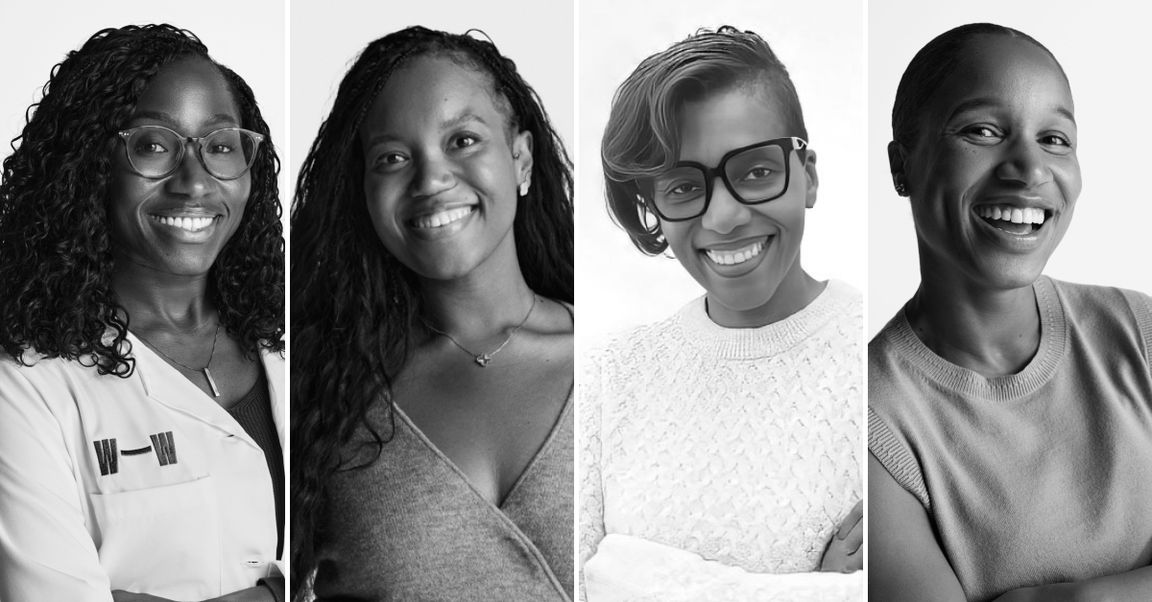
We hear from many Black women coaches and members about unique struggles with medical care, weight loss, and health. These are shaped by generational trauma, stress, health disparities, cultural expectations, and limited access to healthcare. We also live in a society where Black women’s bodies are hyper-criticized and hyper-policed by others. It’s a lot to manage — but you never have to do it alone.
“We want you to feel heard, because in a society where we're often not heard, we're going to create a space where we hear and we support each other,” says Dr. Ashley, M.D., a board-certified family medicine physician and a weight management doctor for Weight Watchers.
Read on for the recap of an honest, inspiring roundtable discussion she moderated between five other Weight Watchers coaches (Chloe A., Cassina, Branneisha AKA Coach B., Alicia, and Angie) about “how to navigate all of that while choosing wellness, choosing yourself, and choosing empowerment.”
What does it mean to change your relationship with food when the family table has historically been a place of celebration for Black women?
Coach Angie: What I've learned on this journey is that it does not have to be an either/or. We don't need to either have our culture or be on a health journey, because those things can be combined. We have to unlearn some of the not-so-healthy habits that we had growing up. Our parents and ancestors had no choices except to eat the scraps that were given to them or left behind for them. Now, we can make better choices. We do have to advocate for ourselves, we have to speak up when we’re at the shared table, and we have to not let the food pushers decide what we're going to enjoy.
Coach Alicia: I realized early-on it wasn't culturally that my food that was the issue. It wasn't the fact that I loved having grits in the morning. It wasn't the fact that my mother made the best cornbread. It was my relationship to it. What Weight Watchers taught me is that I wasn't introducing enough fruits and vegetables. I didn't even think about portion sizes. Like, what's a portion? It was: "Sit down and eat until you are satisfied." That is why Weight Watchers worked for me, because it wasn't about deprivation from these foods; it was about changing the relationship. It would not have worked for me had I needed to give up things that I loved. Because that is how we celebrate with family. Everyone in my family is a great cook, so that wouldn't have worked for me to give up foods that I love, but this program helped me to change that relationship with those foods.
Coach B.: Balance is necessary, but I didn't grow up in a household where balance was taught, so I had to learn it on my own. But I am forever grateful that I chose my health and wellness. The things Weight Watchers have taught me trickled down now to the table, to my family. We still have our greens, our cornbread, all of my favorite stuff, but we will have it in a way that it's just more balanced.
Coach Chloe A.: I agree that it was about changing my relationship with food. I had a very all-or-nothing mentality and a very restrictive diet. Whenever we had big family functions, my Jamaican aunties made the most amazing food. I would have a mindset of: "We have a gathering today, I'm not gonna eat all day until then so that I can just enjoy what I want at dinner." And I had to unlearn that. What would happen, naturally, if you haven't eaten all day, you go to this family function, and you eat way too much. I definitely had to change my relationship with food, and that's what Weight Watchers really taught me.
Dr. Ashley: We’re hearing: "Why are our cultural foods not more represented in the WW app?" I would love to see more of that. The goal is not to make Black women feel like you can't still eat the foods you've grown up loving; it's to try to make you understand that you may just have to approach it a little bit differently. For example, I'm Nigerian. I may have served a family member cauliflower rice once, and she may have cursed me out, so I won't do that again. The question is not, "How do I change who I am?" but "How do I make what I want fit with who I am?"
On a more serious topic, medical bias and mistrust have been some of the biggest obstacles to Black women’s wellness. Have you ever experienced mistrust of the medical profession because of something that was done to you, or felt like you were being dismissed?
Dr. Ashley: When I went through medical school and residency, I had to deal with being the only Black person in the room most of the time. So many times I was asked, "Ashley, what do you think Black people would think about that?" And I remember thinking, "Did I become the voice for all Black people?" No. We have every right to be treated as individuals. Also, there have definitely been instances where I've had to advocate for patients — like, "Listen, this person says she's in pain. Why are we not treating this pain?" And the person just happened to look like me.
Coach Cassina: When I told my doctor, "I really think I'm starting to experience the change — I'm always hot and sweating, which is getting embarrassing" — the man told me, "Well, just wear black." I knew then that I needed to switch up my medical provider, because you're not listening to me, you're not hearing what I'm saying, sir, and you’re dismissing me.
Coach Chloe A.: I had some medical trauma around an emergency C-section that shook me to my core. On top of that, I used to see a non-Black doctor, and I would complain about my periods. I've always had the heaviest periods — if I'm on my period, I gotta wear black pants — the worst cramps, and I would feel fatigued. I started with a new doctor a month ago, an African woman, and she listened and sent me in for blood work and an ultrasound. Not only did I only just find out that I am borderline anemic, so she put me on iron pills, but I also have fibroids. This whole time, I had fibroids, and I had no idea that was why my periods were so heavy and crampy. Within a month of having a new female Black doctor, all these things that I didn't know I was dealing with have been revealed — and now we're addressing them.
Coach B.: I come from a family who have had issues like type 2 diabetes and high blood pressure, and have just been let down by doctors that should be helping. That has really put a distaste for going to the doctor or just seeking medical help in my family, because the attitude is, "What's the point of going? I can just figure this out myself, because if I go, I'm gonna get told to go home anyways, because they're not listening to me."
Dr. Ashley: If you don't feel that you are being listened to, please don't let anybody gaslight you into thinking that you are doing something wrong, or you are a problem, or you are too intimidating or — my very favorite word — “aggressive.” Because if you looked a little different, there are some doctors who would treat your concerns with a little more seriousness. That's not to say that the only way that you're going to get good medical care is with a doctor that looks just like you, because I know a number of doctors that I would personally see who look nothing like me. But if you feel you are being dismissed, it's okay to bring that up. The more you advocate for yourself, the more they may say that you're a problem, but no doctor is ever going to let themselves be sued by giving you subpar medical care, so try not to leave without getting some answers. And if you aren't getting answers, call that office, and ask how to make a report. Don't let anybody tell you that you are not doing the right thing for yourself, because you are.
How has the expectation of always being “the strong Black woman” served or not served you?
Coach Chloe A.: Especially as a mom with two young kids, this idea that having to be strong and do everything is so exhausting. It makes it really hard for me to ask for help because I feel like those around me, even in my family, see me as a strong Black woman. Chloe's got it. Chloe's got it. Those who are very close to me know, if I'm asking you for help, trust me, I've tried every other thing and I actually need your help; I'm not asking for something that I can do myself. But I’m exhausted by this idea of feeling strong in that asking for help sometimes feels like a weakness, and that's something I'm really trying to work on.
Coach B.: I would agree. Growing up, the older Black women in my life — my mom, my aunts, my grandmas — would just be like, "Since you are a Black girl, you're gonna have to try 10 times as hard as everybody else to get a sliver, and you're always gonna be told that you can handle it. And you may not feel like you can, but you have to keep pushing, because that's just what it is." But I want to live a soft life. I don't want to always have it together. I just feel like I'm always carrying everyone else's weight on my shoulders, and it gets to a point where I'm gonna start saying no more. I really challenge myself this year to say no, have hard boundaries, and really prioritize my mental space. I can do it all — but I don't want to anymore.
Coach Angie: Once you get to menopausal age, you will start saying no without issues! My husband and I are in that sandwich generation. My son lives with us, my mom also lives with us, so I am smack-dab right in the middle. If I'm not feeling well, they say the house feels very different because I'm the person with the answers that everybody comes to. Recently, I just broke down to my husband, sitting on his lap. I said, "Sometimes you just want to take the cape off."
Coach Alicia: I read once that the strong Black woman is both a myth and a reality. The myth is that the Black woman is strong and proud, no-nonsense, can handle any hardship, and has all this wisdom — but the reality is that Black women feel they have no other choice and must be this strong in order to survive.
Dr. Ashley:I had to grapple with realizing that stillness and rest were not laziness. One of the biggest obstacles that this whole strong Black woman trope created is that we can't just sit in stillness and be okay with that. But I refuse to let that happen. I turned 40 last year, and I'm sitting in stillness often, because I need the rest. I don't want to do it all. Can I? Maybe — I know I'm strong. But I don't have to prove that to anybody else anymore.
How should we interpret the fact that research says we are more prone to many medical conditions? It’s so negative.
Dr. Ashley: A lot of research articles will come out and say that we are more prone to X, Y, or Z for whatever reasons. If you are getting information that this is just something that Black women have to deal with, or this is just something that Black women are prone to, ask, "What study are you pulling that from?" and, "Where can I get more information about that?" Websites that end with .gov or .edu are good places to do some of your own research as well. You don't have to rely on what someone is telling you just because they're a medical professional, because not all medical professionals specialize in how things affect Black individuals, especially Black women. Look at how long it took Coach Chloe to find out that she had fibroids, which are so prominent in Black women. We are strong, but that doesn't mean that we don't have pain. It doesn't mean that our pain doesn't deserve to be treated. You just have to find the person who's going to take what you need seriously. I saw this quote today: "Black women want the soft life, but that takes a different kind of work. It takes rewiring your nervous system, unlearning survival mode, and learning that stillness is safe and rest isn't laziness. This is the kind of work that teaches your body to stop bracing for impact." We have to stop living as if we're trying to figure out what's coming at us next.
What are some ways Black women doing Weight Watchers can continue the conversation?
Coach Angie: The Weight Watchers’ Black Women's workshops have been in place for six years, and we have 39,000 members in the Black Women's Connect group (which you can join via the Connect section of the app). I love that all these queens come together — from what I call the baby queens, our 20-year-olds, to our queen-agers, who are in their 80s. We're all in one workshop together, and that's just a cultural thing for us. We have our Caribbean queens, we have our Latina queens, we're all in there together. There’s a respect level in those workshops. If somebody’s older than me, there's no way I'm calling them by their first name without a "Miss" in front of it. No one asked us to do that; we're just respectful that way. And there is a Black Women's Workshop every day of the week except Friday. We have wonderful coaches, wonderful queens that attend, and it just gives us an opportunity to be authentically, unapologetically, ourselves. We can talk about things in sort of a shorthand without having to explain ourselves — like whether or not you put sugar in your grits.
Coach Alicia: If you go to one of our Black Women's workshops, you'll find that many of the same members attend each workshop throughout the week, and they have truly built connections — they're like sisters or cousins. It is amazing to see. Come and turn your camera on, get to know one another, or at least participate in chat. Through this virtual space, they know each other and their family members; they have shown up to funerals for one another, and they celebrate one another’s milestones. I'm lucky to be a part of it.
Coach Angie: I love that it really is just all about family and community. You see women with their bonnets on, you see women under the dryer, women getting their nails done, women taking their braids out. You can't get any more comfortable than that.
Coach Cassina: All of the Black women on this panel have amazing workshops all week long. Coach Alicia leads a Menopause workshop on Saturdays. Coach B. is running GLP-1 workshops. Coach Chloe A. is leading Step and strength workouts and amazing workshops. There's so much melanin sprinkled throughout our week — and if you’re not tapping into all the things in your membership, girl, what are you doing?